


Make any visual and image interactive
Any diagram, scan, or map becomes interactive. Participants click, label, and drag elements on the visual.
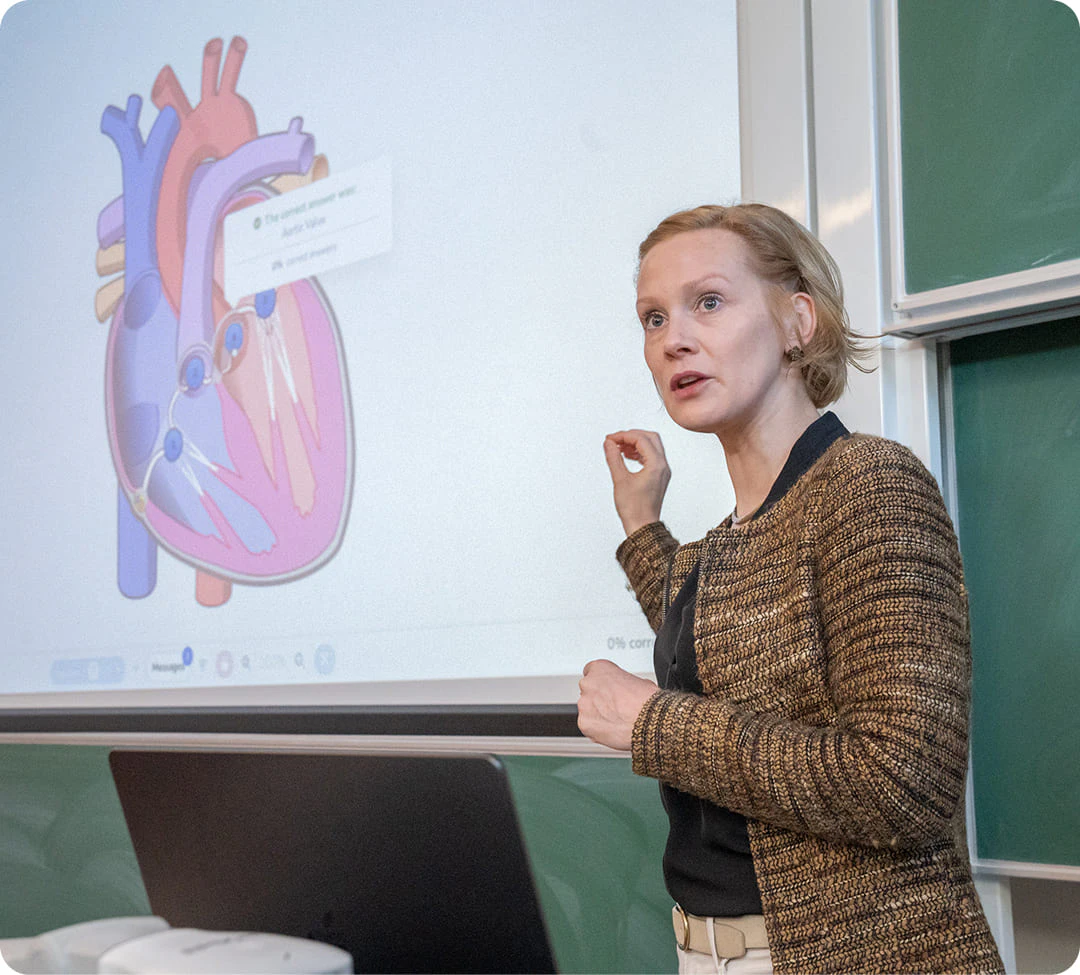
Turn any visual into a question
With Wooclap's image-based question types, participants don't just look at a visual, they click on it, label it, drag elements onto it, and reason through it together, in real time. That's what makes Wooclap an active learning platform: not information delivered at people, but understanding built with them.
From observation to decision
Instead of asking participants to describe what they see, image-based questions require them to act on it, clicking on a location, placing a label, or dragging elements into position. That shift from passive to active is where understanding deepens.
Make misconceptions visible in real time
When participants place labels or identify zones, you see exactly where the learners interpret a visual correctly, and where they don't. No need to wait until the exam to find out.
Works with the visuals you already have
Upload any image from your computer, anatomical diagrams, X-rays, technical schematics, maps, product photos. Supported formats include JPEG, PNG, and GIF, so the visuals you already use in your slides work directly in Wooclap.
Seven ways to make your visuals interactive
Use 3 or 4 of Wooclap's question types with images, diagrams, and visual content to support observation, identification, and deeper reasoning.


When images change how learning happens
When the students actually see a photo of it that they then have to engage with whether it is identifying where something is or labeling it, it really does help the students understand this is how it works in the body.
 Elizabeth GregoryLecturer of Nursing at the College of Coastal Georgia
Radiology has always been taught in an image-rich, interactive environment, but I think what Wooclap does is allow it to be distributed across the entire audience.
 Sheri HarderPediatric Neuroradiologist, BCCH and Clinical Professor of Radiology at the University of British Columbia (UBC)
The student could have a direct look at his decision making and compare with the other students but also with the panel of experts, and it could help to have such kind of a discussion, reflexivity about what is the good or bad professional behaviour.
 Maxime DucretProfessor, Université Claude Bernard Lyon 1
AI that supports effective formative learning
Wooclap's AI helps you create richer learning moments with less effort: it generates MCQ follow-up questions to reinforce understanding, groups open responses into clear themes, summarises brainstorming input, and suggests ideas to enrich any activity. For image-based questions specifically, the Image Labeler agent detects labels on pre-annotated images, places markers automatically, and blurs existing text, so you can turn an existing diagram or slide into a ready-to-use Label an Image question in seconds.
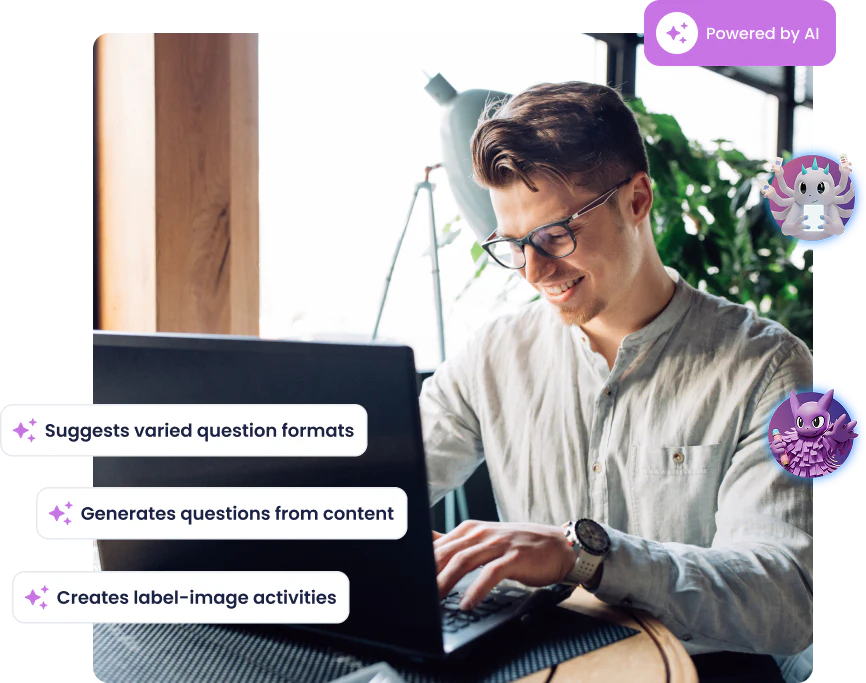
What makes the difference in real teaching situations
From seeing to deciding
Wooclap turns a passive visual into an act of decision, then reasoning before explaining.
Theory with practice
Clicking directly on an authentic visual helps learners connect what they see to a concept
Better recall through visual links
Associating verbal labels, numbers, and visual knowledge creates multi-channel retention and makes abstract content easier to remember.
Understanding visible to everyone
See how the class interprets a diagram in real time, including after the fact, so you can correct early before misconceptions become fixed.
Inclusive participation
Visual questions give every learner a low-barrier way to respond — no need to formulate an answer verbally.
Safe practice to adjust, not learn
In medicine or technical fields, learners can rehearse spatial decisions in a safe environment
Ready to turn your next visual into a question?
Upload any image and create your first image-based question in minutes, whether it's a diagram, a scan, a map, or a product photo.

Frequently asked questions
Have questions? We’ve got answers to help you get the most our your questions
Go further with visual learning
 Neuroscience
No, images don’t always speak for themselves
Discover why a visual alone isn’t enough to learn and how to turn images into tools for attention, reflection, and memory.
 Product update
Drag-and-Drop Question: a new way to check visual understanding
Discover the new Wooclap question: Drag and drop
 Product update
7 Wooclap features to boost visual learning and clinical reasoning in medical education
Discover 7 Wooclap features that boost visual learning and clinical reasoning in medical education.