


Turn listening, reading, and speaking into active language learning.
Wooclap helps instructional teams make comprehension visible, give every learner a voice, and turn passive exposure into genuine acquisition across your language programs, aligned with CEFR and ACTFL frameworks.










Endless ways to boost active language learning
From a 40-student lecture hall to a small oral seminar, Wooclap's interactive tools help learners notice, process, and retain the language they're acquiring.
Built for language pedagogy
Rooted in cognitive science and aligned with CEFR and ACTFL, Wooclap turns listening, reading, and speaking tasks into moments of active processing, not passive exposure.
Flexible across every format
In person, hybrid, online, live or asynchronous. Wooclap adapts to how and where your programs are taught, from 200-student lecture halls to small conversation seminars.
Confidence built with anonymity
Speaking a new language takes courage. Anonymous participation and short, safe speaking turns let even the quietest learners contribute without fear of judgment.
Turn common mistakes into a teaching moment, automatically
Wooclap's Answer Organizer agent groups open written or spoken responses by common themes or error patterns, so your pedagogical staff can spot and correct collective misconceptions in real time during class instead of reading answers one by one.
Support every core language skill with active interaction
From listening comprehension to certification prep, Wooclap gives language faculties ready-to-use, CEFR-aligned activities for every proficiency level.
From guessing to genuine understanding
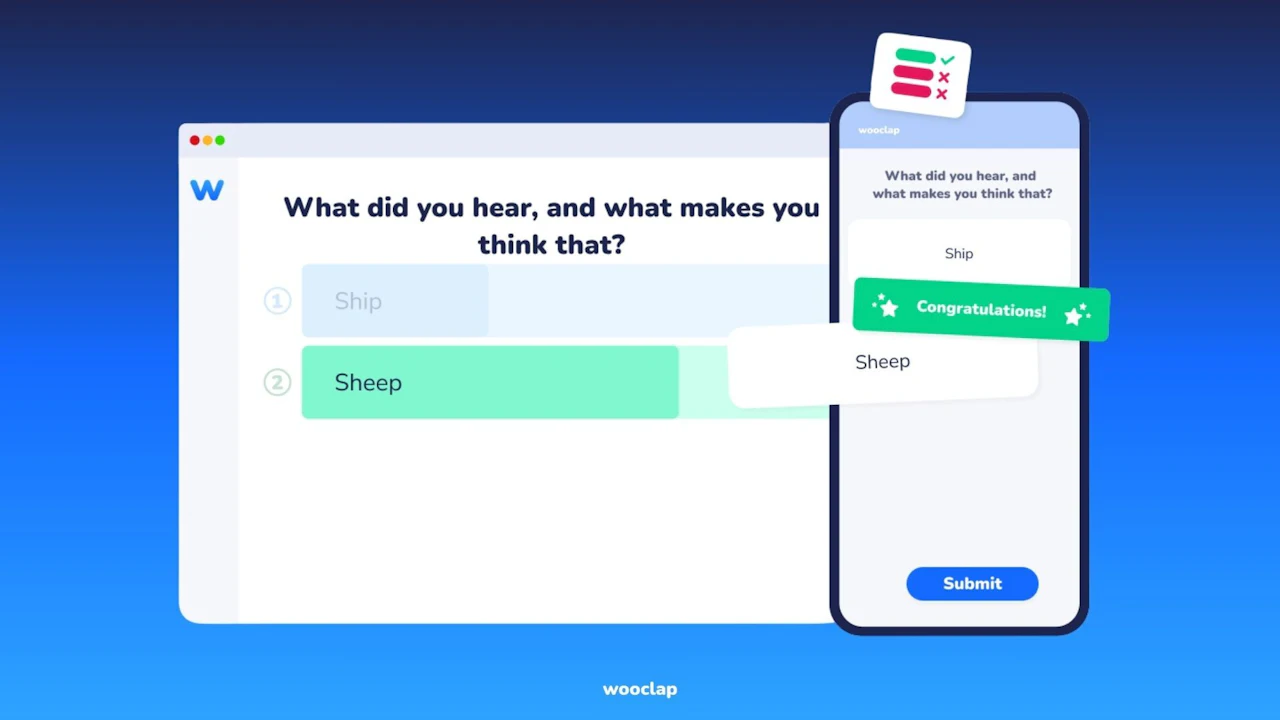
Real-life audio challenges learners with accents, speed, and information density. Embed audio clips directly into questions, minimal pairs, song lyrics, news extracts, to check what students actually heard, not what they guessed. Students listen to minimal pairs (ship/sheep) and select which word they heard. Misunderstandings become visible instantly, and instructors can replay and clarify on the spot.
Real stories, real impact

"I activate the comments feature so students not only select what they think is the correct answer, but also justify their reasoning. It takes a simple poll to another level, because they can defend their choices and reflect more deeply on the language."
Lennie AmoresEducator & Learning Experience Designer, Lincoln University (US)
Features for active language learning
Question types built for language pedagogy, turning every listening, reading, and speaking moment into attention, memory, and confidence.


Connect your favorite tools
Insert interactive questions directly into PowerPoint or Google Slides. Wooclap also integrates with major LMS and videoconferencing tools, no new platform, no added complexity.


Why Wooclap works in every language classroom
From 200-student lecture halls to small oral seminars, on campus, hybrid, or online.
No login required for students
Join instantly via link, QR code, or SSO. No download or account needed.
Anonymity by default
Lowers the affective filter for speaking practice, with individual tracking when it matters.
Live or asynchronous
Real-time sessions or listening/reading exercises assigned as homework.
Seamless LMS integration
Grades and engagement sync to Canvas, Moodle, Blackboard, or Brightspace.
Real stories, real impact
In a traditional classroom, only one person speaks at a time. It's really hard for me as a teacher to give everyone feedback. Wooclap allows me to see what the whole group understands at once.
 Emma AlmingefeldtLecturer, Second & Foreign Language, University of Borås (Sweden)
Wooclap enables the students to engage and to participate in critical thinking. Every student is engaged, every student is involved: pick up your phone and let's vote on this. It's a win-win.
 Hugh MurphyEnglish instructor, Université Libre de Bruxelles, cohorts up to 280 students
Using the participation wheel, it randomizes it, so students don't feel like they're specifically called out. And with Wooclap integrated into Canvas, participation is graded automatically as they answer.
 Lennie AmoresEducator & Learning Experience Designer, Lincoln University (US)








Why active interaction changes how language sticks
Language acquisition research is clear: passive exposure isn't enough. Noticing (Schmidt), processing input actively (Krashen), and getting immediate feedback (Dehaene) are what turn listening and reading into durable memory, and visual, contextual input builds stronger lexical recall (Paivio's dual coding). Wooclap's interactive questions are designed around exactly these principles.
Ready to end the silent classroom in your language department?

Frequently Asked Questions
Everything you need to know about Wooclap for language learning.
Go further
 Wooclap Guides
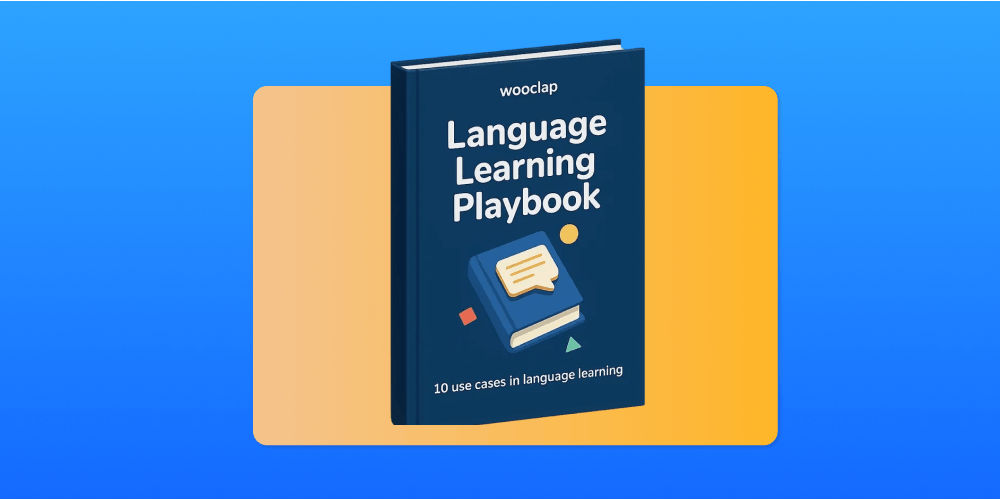
Top 10 use cases to generate engagement in language learning
Discover in this guide the Top 10 Wooclap use cases to generate engagement in language learning.
 Neuroscience
Teaching languages in the age of AI: what if the real challenge is preserving cognitive effort?
As artificial intelligence promises to translate, rephrase, and correct everything, the real challenge for language teaching may lie elsewhere: preserving the cognitive effort, emotion, and human connection that make learning come alive.
 Testimonials
Enhancing student engagement in language learning with Wooclap at Université Libre de Bruxelles
Discover how Wooclap enhances student engagement in language learning at Université libre de Bruxelles.