


Turn every clinical image into an interactive learning experience
From anatomy diagrams to radiology scans, Wooclap's image-based tools help health educators train visual reasoning, boost engagement, and prepare students for real-world clinical practice.
Used by top health education institutions worldwide











Endless ways to boost visual learning
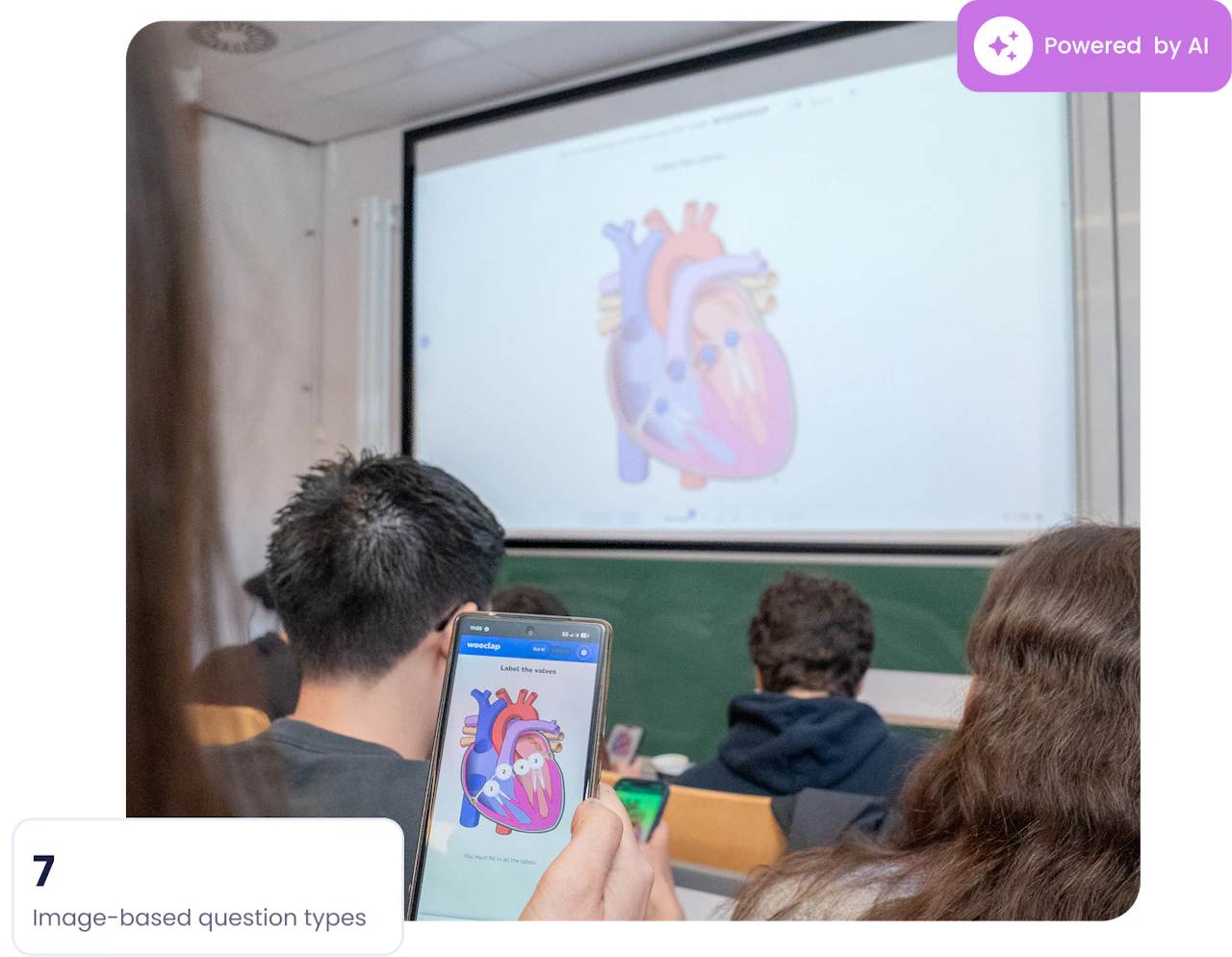
Activate every clinical image with Wooclap’s 7 image-based question types designed for active, real-time participation in health education.
Built for clinical teaching
From anatomy to radiology, Wooclap’s image-based tools turn static visuals into active learning moments that train clinical reasoning, not just content recall.
Flexible across all formats
In person, hybrid, online, live or asynchronous. Wooclap adapts to how and where you teach, from 400-student lecture halls to clinical simulations.
Preparation supported by AI
Wooclap’s AI Image Labeler detects labels on pre-annotated diagrams, places markers automatically, and blurs text, interactive questions in seconds.
🪄 Create image questions in seconds with AI
Wooclap’s AI Image Labeler transforms your existing annotated diagrams into interactive questions automatically, no manual setup required. A unique feature no competitor offers.
Support every health discipline with image-based learning
From classroom engagement to clinical reasoning assessment, Wooclap enables active visual learning across all health education disciplines.
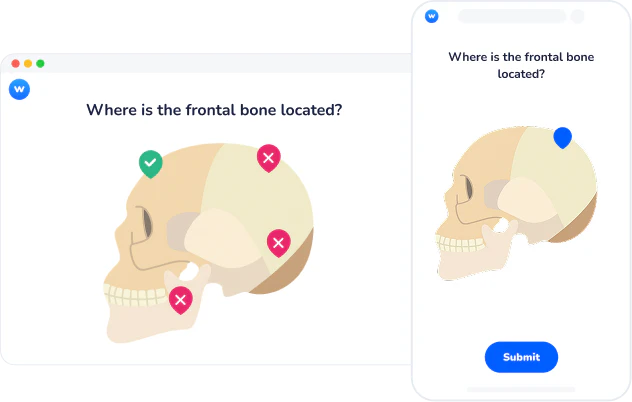
Label bones, muscles, and organs on detailed anatomical diagrams. Use Find on Image to train spatial localization and Drag & Drop for sequencing body systems. Active interaction with anatomical images builds stronger visual memory than passive observation.
Real stories, real impact

In radiology, you need students to actually look at images and reason about what they see. Wooclap’s Find on Image and Label an Image create exactly that active engagement with diagnostic visuals.
Sheri HarderPediatric Neuroradiologist, Clinical Professor of Radiology, University of British Columbia
Features for visual clinical learning
Image-based tools and clinical reasoning formats, turning every visual into a moment of attention, memory, and critical thinking.



Connect Wooclap to your favorite tools
Insert interactive questions directly into PowerPoint or Google Slides. Wooclap also integrates with major LMS and videoconferencing tools.


Why Wooclap works in every health education classroom
From 500-student lecture halls to small clinical groups, on campus, hybrid, or online.
No login required for students
Join instantly via link, QR code, or SSO, no download or account needed.
Anonymity by default
Wide participation with individual tracking when it matters.
Live or asynchronous
Real-time sessions or visual exercises assigned as homework.
Seamless LMS integration
Grades and engagement sync to Canvas, Moodle, or Blackboard.
Clear reports
Monitor results by student or question and track visual learning progress over time.
Works on any device
Phones, laptops, or tablets, during lectures or clinical rotations.
Real stories, real impact
Radiology has always been taught in an image-rich environment that's interactive, and Wooclap allows it to be distributed across the entire audience.
 Sheri HarderPediatric Neuroradiologist, BCCH Clinical Professor of Radiology at University of British Columbia
TCS and TCG aim to assess decision-making capacities. The student can compare his decision-making with other students and also with the panel of experts.
 Maxime DucretProfessor at Université Claude Bernard Lyon 1 and Hospital Physician at the Hospices Civils de Lyon
This is one of the questions where the students will have to mark on a syringe where they would draw up to...which really helps bridge that gap between school and practice.
 Elizabeth GregoryLecturer of Nursing at the College of Coastal Georgia
Used by top health education institutions worldwide











Why interacting with images changes how students learn
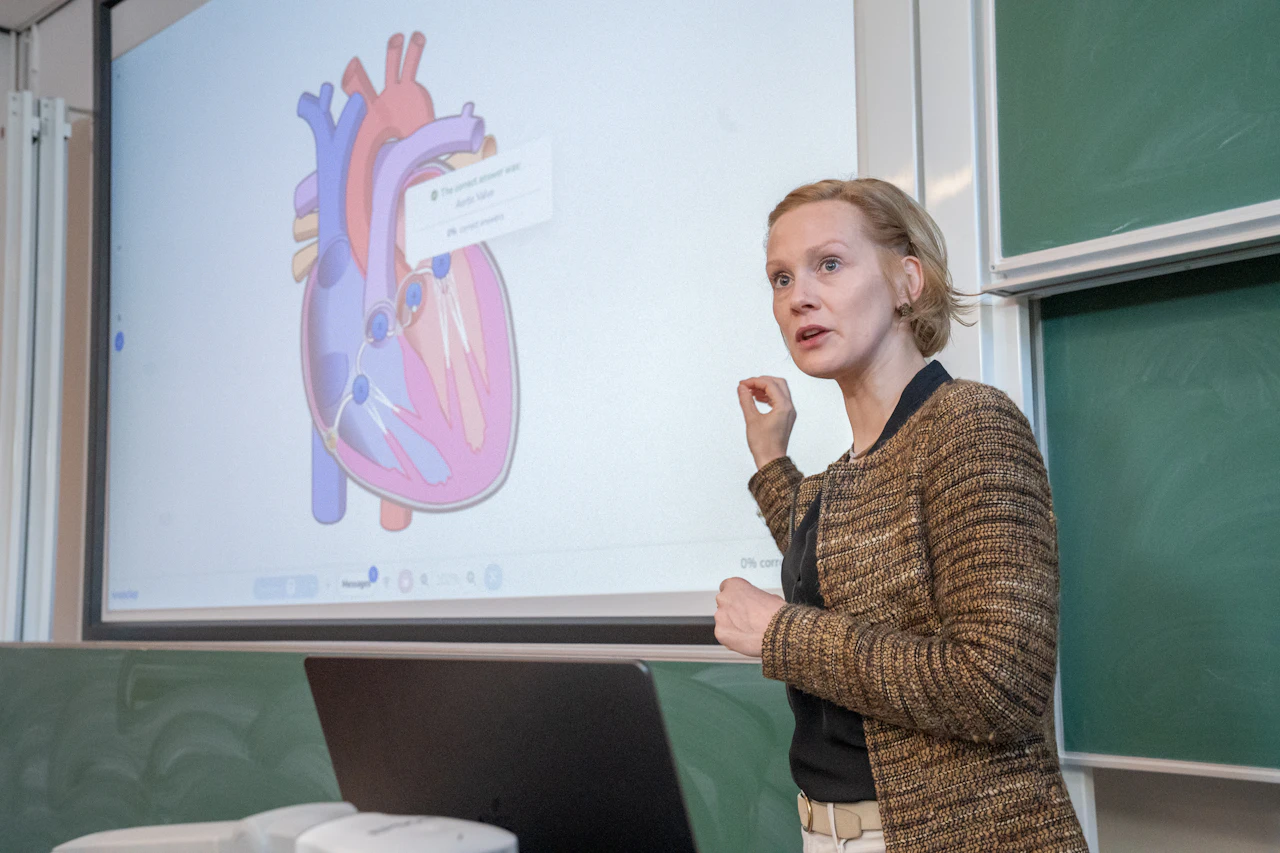
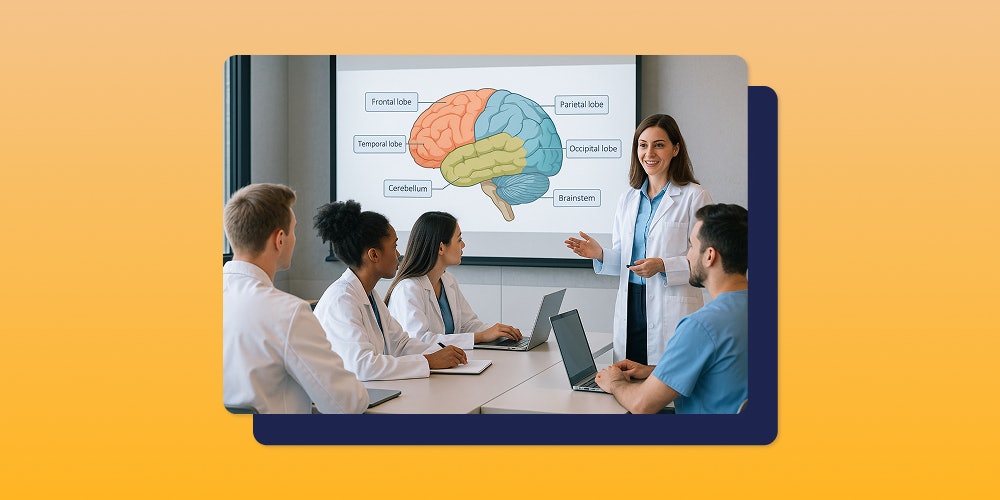
Neuroeducation research is clear: passive observation isn't enough. Actively engaging with images, clicking, labeling, manipulating, triggers deeper memory encoding (Allan Paivio, 1986; Clark & Lyons, 2010). For radiologists, pathologists, and anatomists, this is how clinical pattern recognition is built. Wooclap's image-based questions are designed around exactly this principle
Make health education more active and engaging with Wooclap
Make health education more active and engaging with Wooclap
Frequently Asked Questions
Everything you need to know about Wooclap for health education.
RESOURCES
 Product update
7 Wooclap features to boost visual learning and clinical reasoning in medical education
Discover 7 Wooclap features that boost visual learning and clinical reasoning in medical education.
 Testimonials
NCLEX and nursing education: Why Wooclap is emerging as a key pedagogical ally
Discover how Wooclap helps prepare students with interactive and visual clinical cases.
 Neuroscience
No, images don’t always speak for themselves
Discover why a visual alone isn’t enough to learn and how to turn images into tools for attention, reflection, and memory.