


Train reasoning beyond right and wrong
Concordance questions make it easy for teachers, trainers, or educators to run Script and Judgement Concordance tests directly in Wooclap. They can collect expert responses, gather learner answers, and compare both in real time. By revealing expert justifications, this format helps learners understand how new information reshapes a hypothesis or decision, and allows educators to assess complex reasoning rather than a single “right” answer.
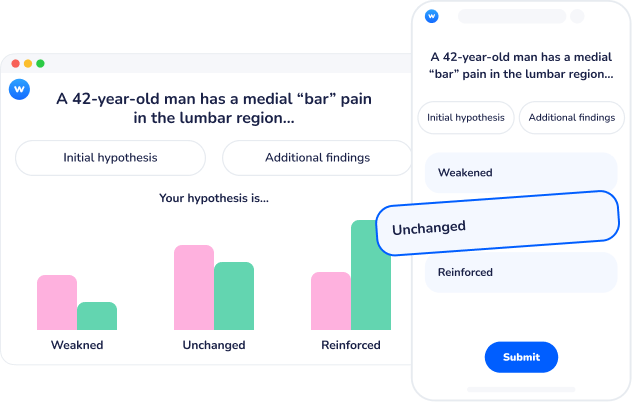
Master the art of professional decision-making
Think like an expert
Concordance focuses on how learners reason when information is incomplete or ambiguous, mirroring real-life decision-making instead of textbook certainty.
Reveal reasoning, not just answers
Rather than checking correctness alone, the feature highlights how learners reason in situations of uncertainty and how their judgments align with expert perspectives.
Compare perspectives at scale
Learner responses can be compared against expert panels or reference answers, helping participants understand variability in professional judgement.
Assess the process, not just the result
Traditional assessments often fail to capture the reasoning behind a choice. Concordance tests allow you to see if a learner’s reasoning aligns with established professional scripts. By visualizing expert consensus, you can identify if a statement is prone to specific biases or errors in judgment before they enter the field.
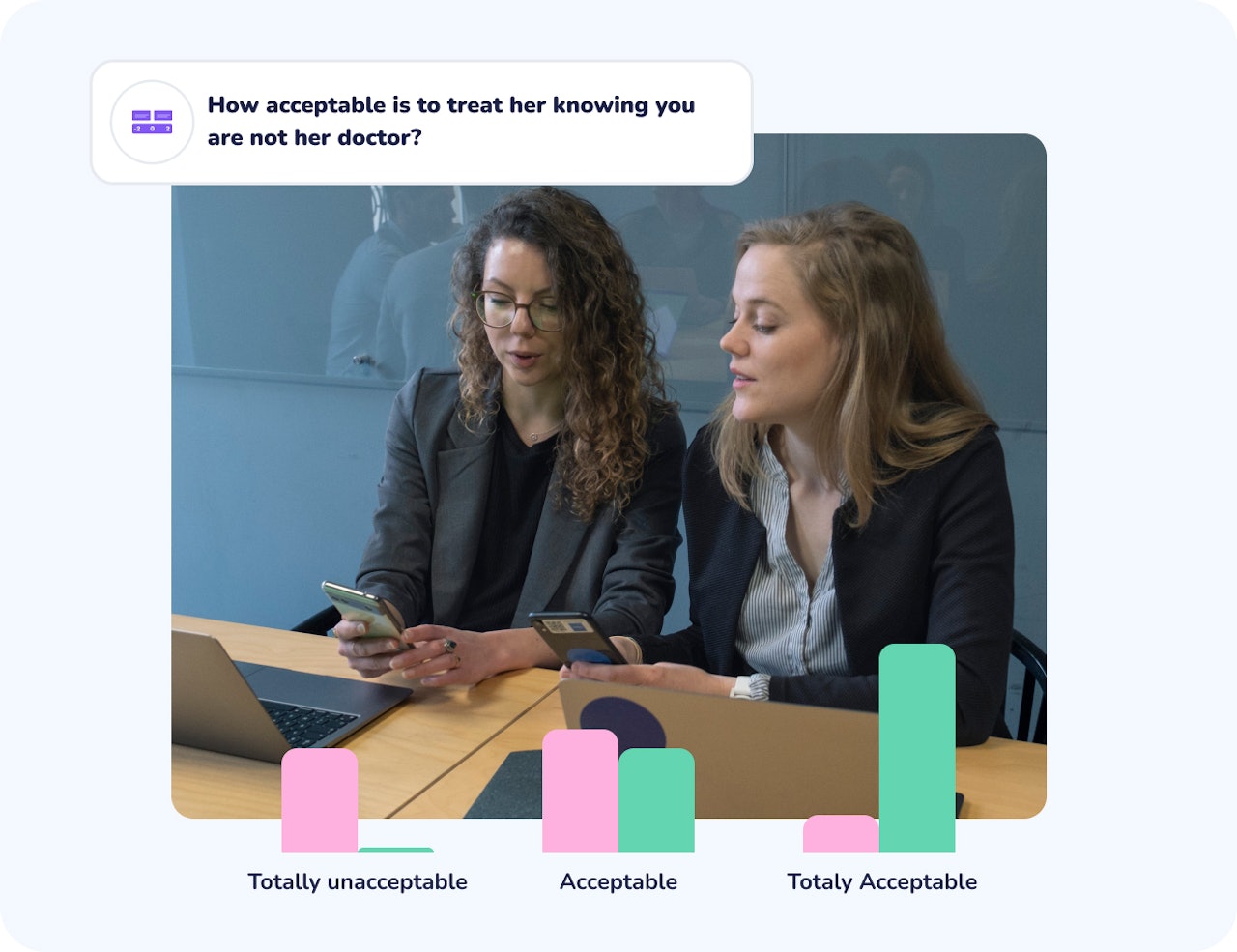
Flexible for any professional discipline
Whether you are using the Script Concordance format to test clinical hypotheses in medicine or the Judgment Concordance format to evaluate ethical behavior in business or law, Wooclap provides a unified interface. This flexibility allows you to simulate the exact type of pressure and ambiguity your students will face in their careers.
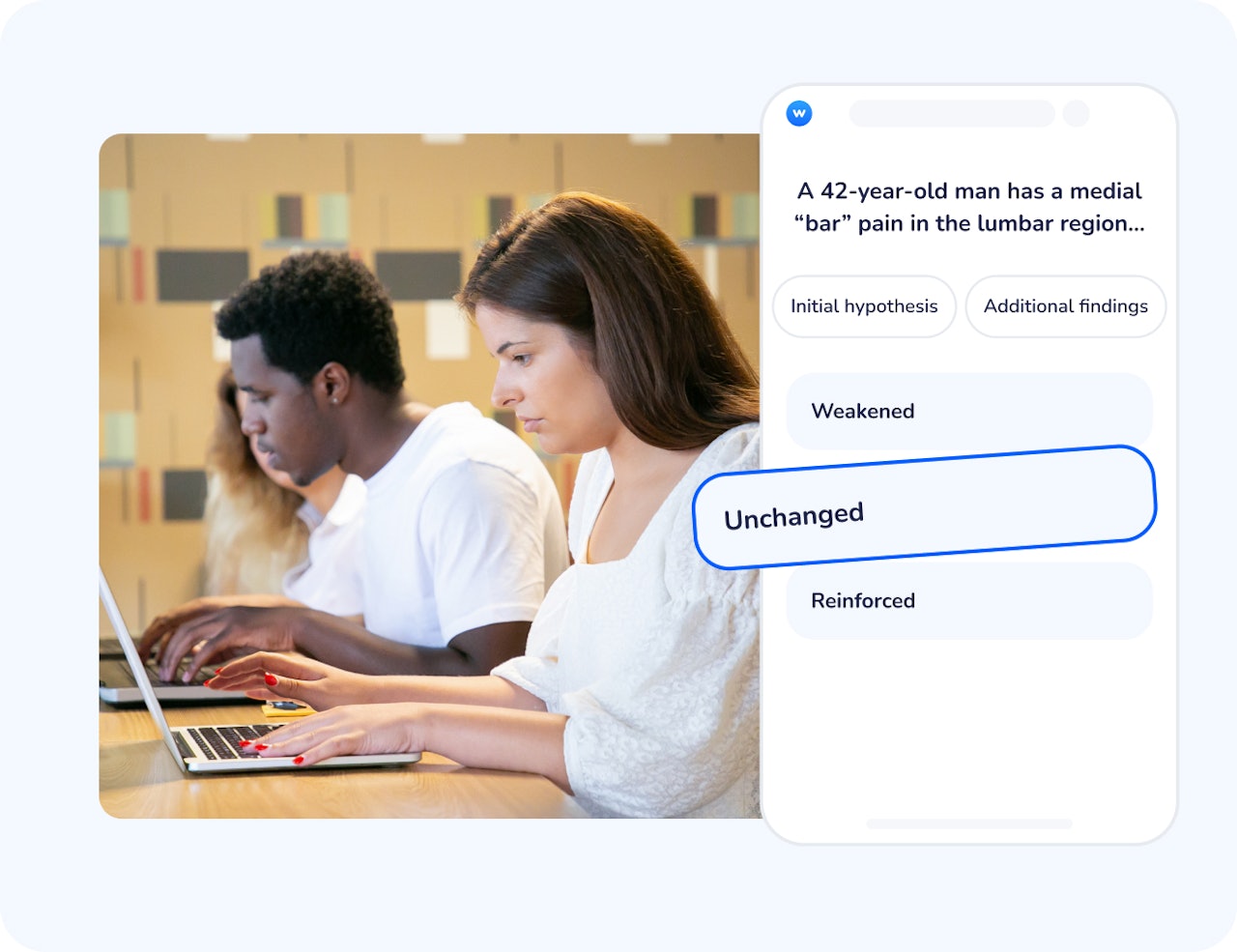
How concordance works
Present a scenario
Define a realistic situation that requires interpretation, judgment, or decision-making in conditions of uncertainty.
Learners submit their judgment and justification
Participants evaluate the situation using a predefined scale and provide a brief comment to explain their reasoning.
Compare with expert panels
Learner responses are compared with those of an expert panel, making differences in reasoning visible and opening discussion around professional judgment.
How teachers and trainers use concordance
Concordance is used when learning objectives involve judgement, interpretation, or decision-making.
Medical and health education
Assess clinical reasoning by asking how new symptoms or test results affect a diagnosis.
Law and ethics training
Explore how additional evidence influences legal interpretation or ethical decisions.
Risk and safety training
Evaluate how new constraints or incidents impact risk assessment and action plans.
Advanced professional training
Support expert reasoning in fields where multiple answers can coexist depending on context.
Design activities with a little extra support
Wooclap’s AI agents help you move from ideas to structured activities more easily. They support question creation and review, helping you gain clarity and save time while you remain in control of every pedagogical choice.
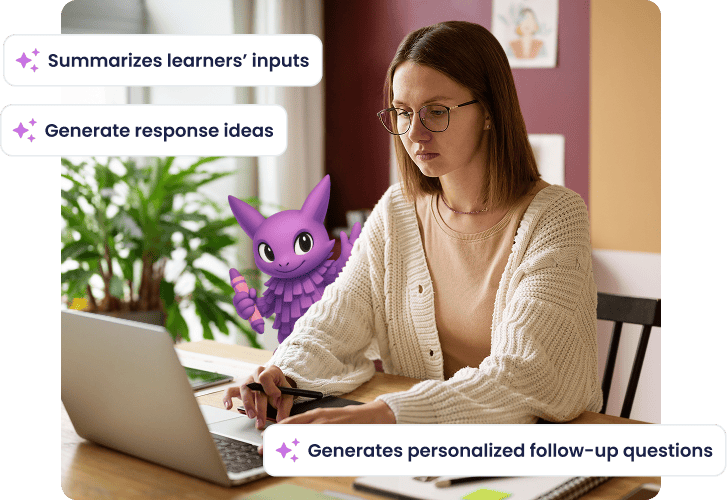
Assess reasoning where certainty does not exist
Create hypothesis-based questions
Design scenarios where learners must evaluate how new information impacts an initial judgement.
Use graduated judgement scales
Allow participants to express nuanced reasoning instead of binary answers.
Collect individual or group responses
Gather judgements from an entire audience in real time or asynchronously.
Compare with reference answers
Benchmark learner reasoning against expert panels or predefined responses.
Reveal diversity of judgement
Visualise how different learners interpret the same information differently.
Support high-level decision skills
Train learners to reason, justify, and adjust decisions in complex situations.
Train judgement, not just knowledge
Create concordance tests that reflect real-world decision-making and help learners reason with confidence.

Frequently asked questions
Have questions? We’ve got answers to help you !