


Check numerical understanding
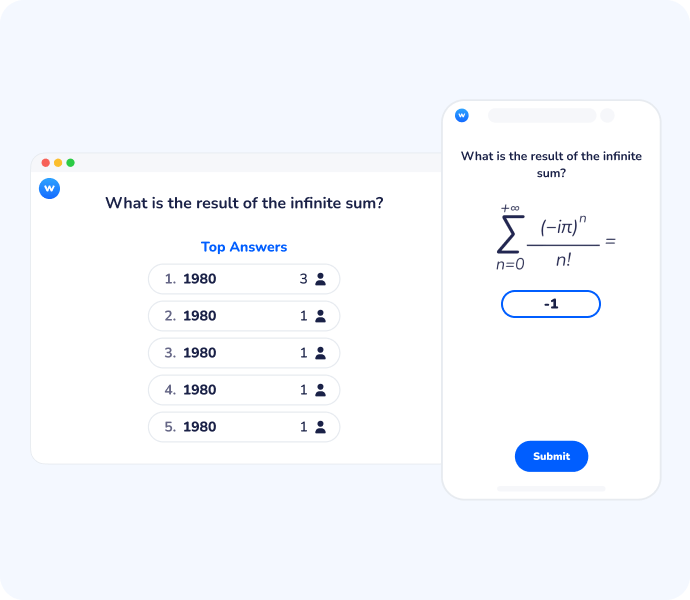
Find a number asks participants to produce a numerical answer. You define the correct value and can allow a tolerance when approximation is part of the task. This makes it easy to check calculations, estimations, or data reading, live or asynchronously.
Check numerical understanding, not recognition
Learners must produce an answer
With Find a number, participants cannot rely on recognition or elimination. They must calculate or reason their way to a value and enter it themselves, which gives you a clearer signal of understanding.
Precision with flexibility
You can define a correct answer and allow a tolerance range when slight variation is acceptable.This makes the feature suitable for real learning situations involving rounding, measurement, or estimation.
Make numerical reasoning immediately visible
Responses can be reviewed as a list or a diagram , with access to frequent answers and statistics. This helps you quickly identify correct reasoning and common errors.
When the goal is to verify reasoning
Find a number is particularly useful when you want to check whether learners can correctly apply a method, formula, or rule. Because participants must enter a value, you can see immediately who reached the expected result and who did not. This makes it easier to decide whether to move forward, revisit a concept, or clarify a specific step in the reasoning process.

When reasoning matters more than exact values
In many learning situations, arriving at an exact value is less important than reasoning within an acceptable range. By allowing a tolerance, Find a Number reflects these conditions more accurately. Learners can focus on the logic behind their answer, while you assess whether their reasoning is sound rather than penalising minor variation.
How Find a number works
Write a question with a numerical answer
Create a question that requires a numerical answer. Define the expected value and decide whether the question should be graded or used only to collect responses.
Set validation rules
If needed, add a tolerance to accept close answers. You can also define minimum and maximum values to guide participants and avoid irrelevant inputs.
Collect and review answers
Participants type their answer and submit it. You can view responses live or after the activity, including the correct answer, frequent responses, and statistics.
How teachers and trainers use Find a number
Find a number is used whenever learners need to calculate, estimate, or interpret numerical information as part of an activity or assessment.
STEM education
Check calculations, measurements, or numerical problem solving after an explanation or worked example.
Health and medical training
Validate dosage calculations, thresholds, or numerical indicators used in clinical reasoning.
Social sciences and economics
Ask learners to extract values from charts, tables, or datasets and interpret quantitative information.
Business and professional training
Assess understanding of KPIs, financial figures, targets, or operational metrics.
Get support while designing and reviewing activities
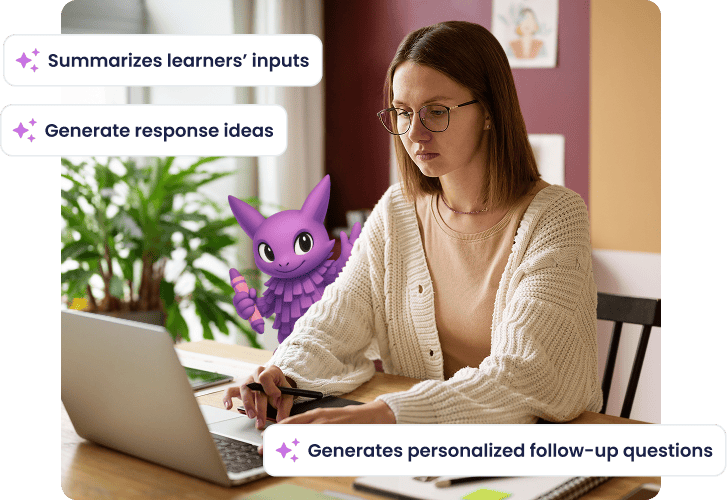
Wooclap’s AI agents assist you at different moments of an activity, from preparation to review. They help clarify ideas, suggest relevant questions, and reduce manual work, so you can focus on facilitation and interaction rather than setup.
A focused way to check numerical understanding
Ask for a numerical answer
Participants type a value themselves, rather than selecting from predefined options.
Define a correct result
Set the expected answer to clearly validate whether the reasoning leads to the right outcome.
Accept close answers when needed
Use a tolerance range to allow approximation when exact precision is not required.
Guide input with limits
Set minimum and maximum values to prevent irrelevant or unrealistic responses.
Review results efficiently
Access participant answers along with frequent responses and basic statistics.
Use in any pacing
Run the question live during a session or in Self-Paced session.
See if the numbers add up
Use Find a number to check understanding in real time or asynchronously.

Frequently asked questions
Have questions? We’ve got answers to help you get the most our your....