


Sequential thinking, made interactive
Wooclap's Sorting question asks participants to arrange elements in the correct order, steps in a process, events on a timeline, concepts in a hierarchy, directly from their own device. It turns a passive comprehension check into an active reasoning exercise, useful in any discipline and at any level.
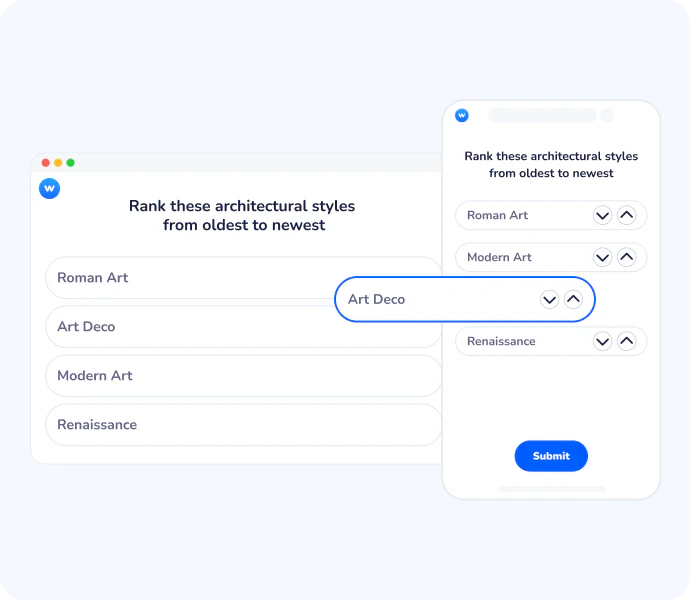




Why Sorting works for deeper learning
Beyond recall: reasoning made visible
It challenges learners to compare, sequence, and justify, revealing how they think, not just what they know. Misconceptions about cause-and-effect chains or process logic become immediately visible.
Instant formative insight
As soon as participants submit, you see the most frequent orderings in real time. That live view lets you spot common errors, adapt your explanation on the fly, and open a discussion grounded in what the group actually understood.
Flexible across subjects and formats
From historical timelines to scientific steps, vocabulary classification to business process flows, Sorting adapts to any content. It works equally well live, in team mode, or assigned asynchronously for self-paced learning.
From passive listening to active decision-making
When learners physically arrange elements into an order, they engage a different cognitive level than reading or selecting an answer. They have to compare, evaluate, and commit, which strengthens both understanding and long-term retention. For instructors, that interaction surfaces reasoning that a multiple-choice question never would.
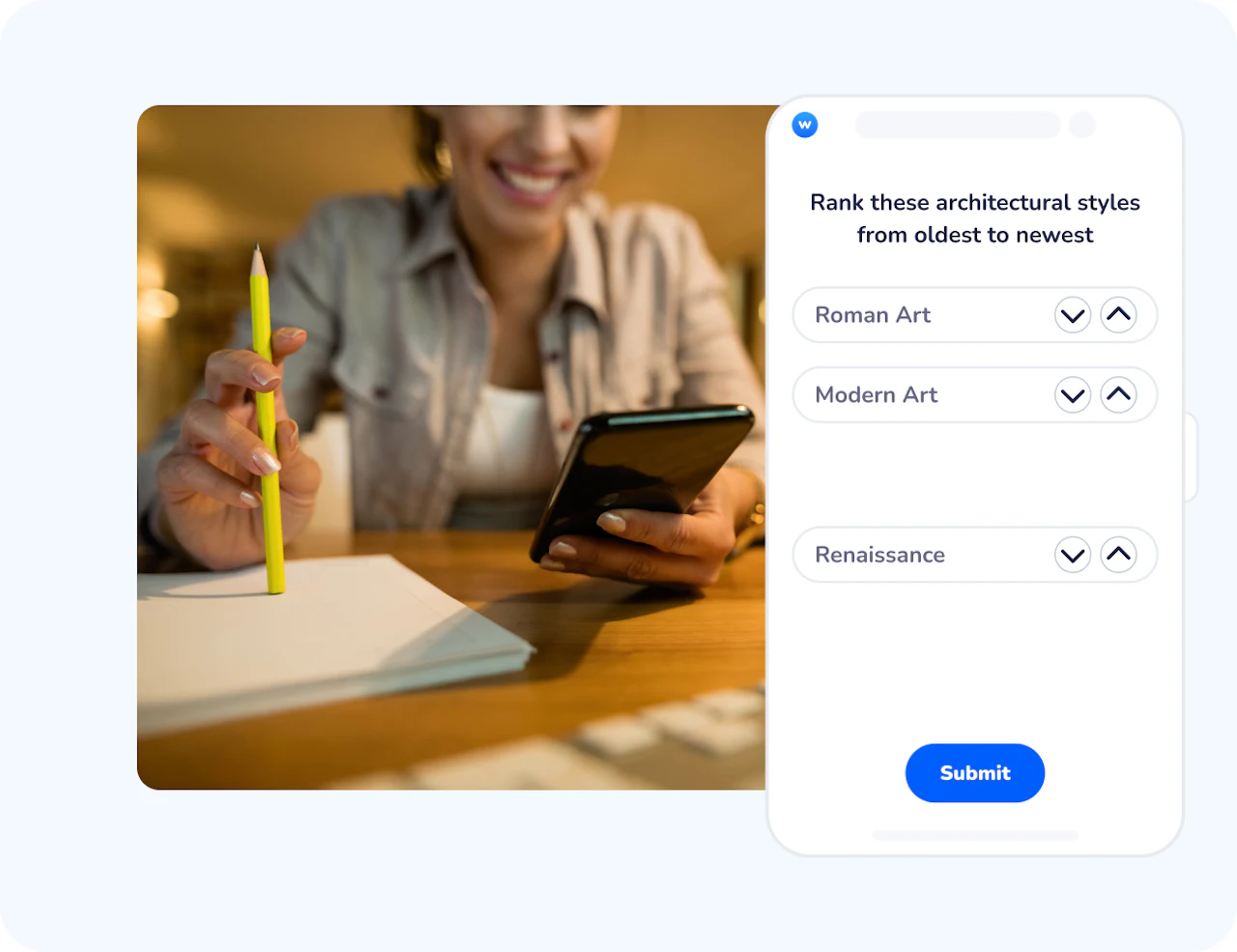
A quick check-in that generates real discussion
Sorting questions are fast to run and rich to debrief. Display the most frequent orderings to the group, highlight where answers diverged, and ask learners to justify their choices. What starts as a two-minute activity can anchor a ten-minute discussion around exactly the concepts that need clarification.

How Sorting works
Create your activity
Open any Wooclap event, click New question, and choose Sorting under Assess Understanding. Write your question and enter the elements participants will need to organise, defining the correct order as you go. Optionally add a timer to keep the activity focused.
Launch live or asynchronously
Share your event code and let participants join from any device. Each person arranges the elements into their preferred order on their own screen. Run it during a live session or assign it for independent work, the experience is identical either way.
Review and debrief
Once responses are in, display the most frequent orderings and reveal the correct answer. Use the live view to spot where participants diverged, address misconceptions directly, and prompt discussion. Export the results to track participation and progress over time.
How teachers and trainers use Sorting
Sorting fits any situation where understanding order, hierarchy, or classification is central to the learning goal. It works in classrooms, training rooms, and online sessions, wherever you need learners to show their reasoning, not just their answer.
History & social sciences
Students reorder key events, milestones, or arguments into the correct chronological or logical flow, testing their grasp of cause-and-effect beyond simple recall.
Sciences & medicine
Instructors ask learners to sequence steps in a biological process, a chemical reaction, or a clinical protocol, revealing whether they understand the underlying logic.
Language learning
Teachers use Sorting to have students reconstruct sentence structures, arrange vocabulary by register or complexity, or order stages of a narrative.
Corporate & professional training
Trainers apply Sorting to process flows, compliance steps, or decision trees, checking that employees understand the correct sequence before going live.
AI that supports effective formative learning
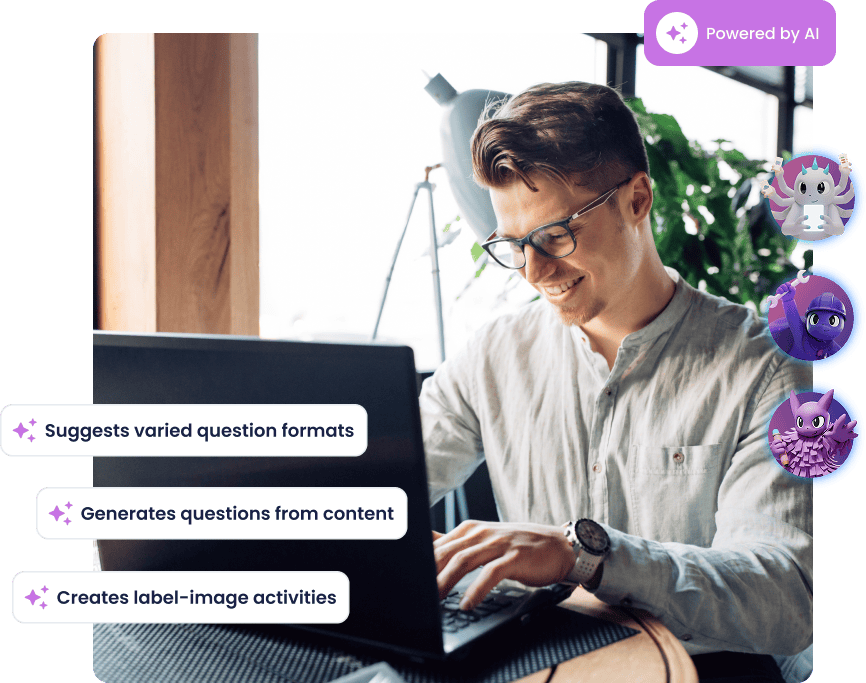
Wooclap's AI helps you create richer learning moments with less effort: it generates MCQ follow-up questions to reinforce understanding, groups open responses into clear themes, summarises brainstorming input, and suggests ideas to enrich any activity. These agents save time, surface misconceptions earlier, and help you focus on guiding deeper learning.
Everything you need to run a Sorting activity
Simple, intuitive interaction
Participants arrange elements into their chosen order directly on their device, no instructions needed, works on any smartphone, tablet, or computer.
Correct order defined by you
Enter the elements and set the right sequence when creating the question. Wooclap automatically scores responses and displays results against the correct answer.
Real-time response display
See the most frequent orderings as responses come in, so you can instantly identify where participants agree, diverge, or go wrong.
Individual or team mode
Run Sorting as a solo exercise or switch to Team Mode for collaborative problem-solving, participants work together on a shared screen to agree on the right order.
Built-in timer
Add a countdown to keep the activity focused and encourage quick, committed thinking. The timer starts automatically when the question is displayed.
Live and asynchronous compatibility
Use Sorting during a live session for instant group feedback, or assign it in participant-paced mode for flipped classrooms, homework, or self-paced training.
Help your learners organise their thinking, literally
Write your question, enter the elements, and let participants show you how they reason. No complex setup, just create an event, add a Sorting question, and go.

Frequently asked questions
Have questions? We’ve got answers to help you get the most our your questions