

Empowering educators and engaging students at the University of Cape Town
30.07.2026 • 3 minutes
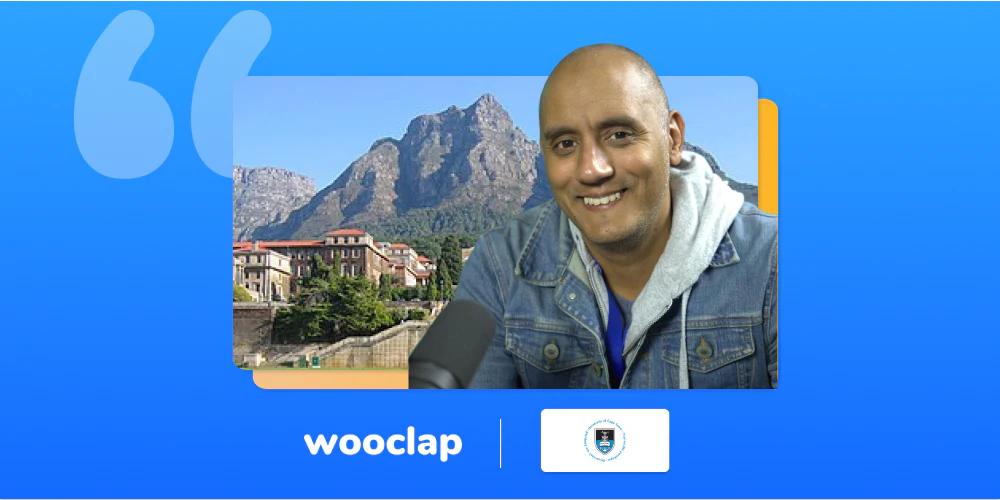
At the University of Cape Town (UCT), active learning is not just about the tools, it is about moving from a simple "information repository" to a framework where students reflect on their own learning process. By providing bespoke support and structured training, the institution ensures that digital transformation is a strategic advantage rather than an administrative burden.
Guest: Zaaid Orrie, Learning Technology Services Manager, University of Cape Town (UCT).
When you hear the term "active learning," what does it look like in the daily reality of your institution?
Zaaid Orrie: UCT is a large institution, so we focus on creating frameworks rather than rigid policies, allowing individual departments to lead their own implementation. From my perspective, active learning goes beyond studying content; it involves students actively thinking about their own learning process.
In practice, this often takes the form of blended learning. We make extensive use of discussion forums where students share their feedback, thoughts, and personal experiences regarding the course material. It’s about ensuring information is ingrained within the student so they can take it forward into the world.
Could you share specific projects where teaching methods were redesigned to increase engagement?
Z.O.: We have several teams within our department, CILT (Center for Innovation in Learning and Teaching), focused on this. The Academic Staff Development (ASD) team runs workshops for lecturers on pedagogical frameworks and course design.
A very recent example is our "AI Community of Practice." We launched this to address the anxiety around Artificial Intelligence. Every department is different, some are advanced, while others, like Humanities, have more concerns. This project allows different departments to showcase how they are practically implementing AI. We used Wooclap to facilitate the introduction and then created breakout rooms for different tools. It’s a way for departments to share knowledge so they become less fearful and see how to redesign curriculum and assessment strategies effectively.
How do you encourage faculty to adopt these active methods without it feeling like a burden?
Z.O.: We realize we can only do so much from the top down, so we use a variety of voluntary, "bottom-up" strategies. This year, we launched Amathuba Accelerate. Instead of just providing a platform, we go into specific departments to analyze their pain points and discuss how to use tools bespoke to their needs.
We also run the Amathuba Essentials Program twice a year. It’s a week-long blended program where lecturers and staff learn the basics of our systems through actual exercises. They don't just read; they have to implement what they’ve learned and share screenshots or feedback on a daily discussion board. We offer a badge for completion, which serves as a motivator. By focusing on their specific needs and providing structured support, we make the shift feel like a benefit rather than a chore.
We used Wooclap to facilitate the introduction and then created breakout rooms for different tools. It’s a way for departments to share knowledge so they become less fearful and see how to redesign curriculum and assessment strategies effectively.
Zaaid Orrie, Learning Technology Services Manager at the University of Cape Town (UCT)
In traditional lectures, there is often a "blind spot" regarding student understanding. How are your educators catching misconceptions in real-time?
Z.O.: We are currently rolling out data analytics within our learning management system (Brightspace). We’ve spent the last year creating "triggers." For example, if a student’s grades drop below a certain threshold after a few assessments, it triggers an alert for the lecturer. This allows the teacher to intervene before the student "falls through the cracks."
Of course, the quality of this data depends on lecturers consistently inputting grades. Outside of that, tools like Wooclap and Padlet give lecturers a real-time "feeling" for how students are engaging and where they might be struggling. While it’s not 100% accurate because it relies on student-reported feelings, it allows teachers to adapt their teaching on the fly. If an intervention is needed, the lecturer might approach the student directly or refer them to student affairs for personal or academic support.
Looking ahead, how do you see the role of technology evolving to foster genuine curiosity rather than just digitizing old habits?
Z.O.: We are moving beyond the basics. Our current goal is to launch an Amathuba Advanced Course. While our "Essentials" course covers the basics, the advanced version will focus on third-party tools, like Wooclap, and creative AI features to make courses more engaging.
We've seen a massive turnout for our recent training programs, which tells me there is a genuine curiosity among the staff. When you give educators the time and space to explore these technologies, they move away from just digitizing old habits and start finding ways to make their sessions more interactive and exploration-based.


A monthly summary of our product updates and our latest published content, directly in your inbox.