

How to make every team meeting interactive and engaging
20.07.2026 • 12 minutes
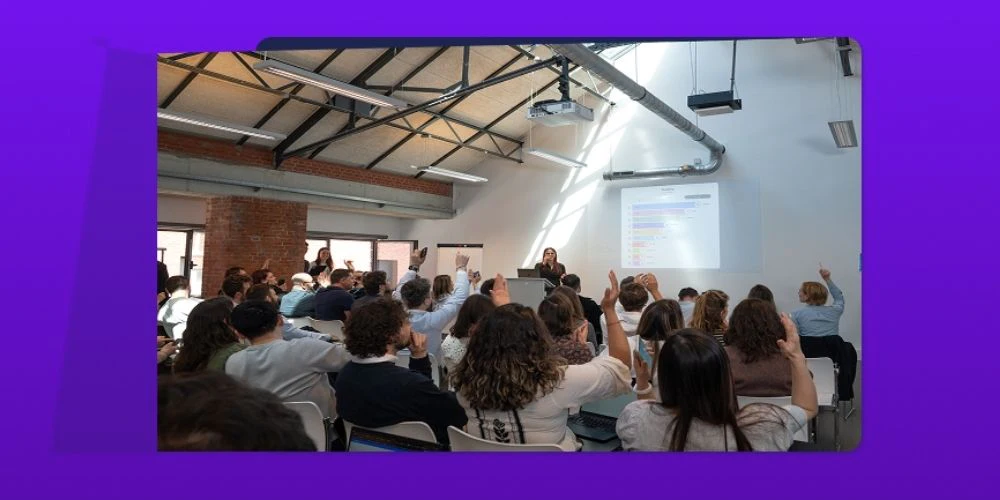
Most organizations run meetings that are long and one-sided presentations, during which 1 in 3 executives has already fallen asleep, not zoning out or bored, but asleep. Sounds familiar? You’re not alone. Many great teams face the same challenge, team communication breaks down when everyone is watching and not contributing.
The problem here is not the meeting in itself, it’s the lack of trust, communication and participation. Team building activities are the fix, it’s all about getting team members involved: better communication, trust and collaboration. This is your guide to the best team building activities and quick team building ideas for any team size, any workplace, any type of work meeting, any schedule.
Key Takeaways:
- Quick team building activities, even five minutes, improve communication skills, teamwork and collaboration when done consistently
- The best team building games and exercises work for any group size, from small groups of five to larger teams of 50 and above
- Virtual team building activities are just as effective as in-person when remote participants are given equal opportunity to engage
- Free team building ideas like icebreakers, live polls and word clouds need no budget, no materials and no preparation
- Regular team building exercises and team bonding activities build psychological safety, strengthen communication and improve workplace culture one meeting at a time
Table of contents
Why team building activities matter more than you think
Team building activities are exercises designed to improve a team's communication, collaboration and trust, enhancing productivity in the process.
The right team building games and exercises help employees create better workplace connections, build trust, improve communication and how they collaborate as a company. Most teams don’t give team building the importance it deserves. It is treated as an obligatory activity rather than a great chance to improve.
Regular team bonding activities strengthen communication, collaboration, trust and improve how a workplace performs. Team members who consistently share ideas, take on new challenges and problem solving exercises together develop skills that enhance over time.
How team building activities directly impact performance
Team members who feel safe to speak up, share ideas and take risks without fear are the strongest predictors of performance. Psychology plays a great role in team communication.
When every person feels safe to speak, great changes happen. One of the best ways to build this is by implementing team building activities. Participants communicate more freely when they feel more involved rather than being passive observers in a structured meeting. This directly helps in improving how team members perform, sharpens their problem-solving skills that makes challenges easier to handle.
Teams that start with a simple exercise will have a quick improvement in trust and problem-solving skills and find it easier to work through challenges together. When each person feels challenged, they engage and create better working relationships. This will also improve the company’s work culture and productivity.
What happens when your team stops engaging
Disengagement might not seem like a major problem initially. But it is gradual and quiet: people stop contributing, meetings become one-sided, creativity and productivity slowly fade out. Over time, this will affect the team’s work output. Regular team bonding activities, even short ones, build the connection that keeps great communication and collaboration strong. A team that does not engage is less likely to communicate. This can create a real challenge for the entire workplace.
Quick team building activities for meetings
You don’t need long sessions or a dedicated place to run a team building activity, a simple game works well. Some of the most effective exercises take less time than a status update. Here are the quick team building activity ideas and activities to get your team playing and engaged. These activities work great for any group size, whether it’s five or larger groups of people.
The best icebreaker questions to kick off any meeting
A great icebreaker does not need to be too professional or deep. It can be something very simple, great for getting every person talking before the actual agenda begins. The right question helps create a shift in energy and gets each person participative. This will feel natural and will improve and carry on throughout the session. A few questions that will work for any group:
- What’s something you’ve learned this week that surprised you?
- If we could change one thing about how we run meetings, what would that be?
- What’s the worst piece of advice you’ve received?
Start with a simple question and build from there, even a one-liner that is effective These are also great free team building ideas that require no preparation. Need more ideas? Wooclap has 55 icebreaker questions ready to use, and a set of team building icebreaker templates which can help you find the right one for your group.

5 team building icebreakers that actually work
These fun team building games help participants start conversations, build trust, improve communication and share a bit about themselves with the group.
- Two truths and a lie: Each team member shares two truths and a lie about themself. The group guesses the lie and the truths. This simple game works every time, it’s fast, fun, starts new thinking and instills curiosity in participants.
- Word association: One person says a word and the next one says the first thing that comes to their mind associated with the word. It sounds simple but works brilliantly to get participants laughing at each other’s wit.
- Deserted island picks: Ask everyone what they would take with them while being stranded on a deserted island. This will tell you more about the team. It starts a real conversation, improves how participants understand each other and displays their creative thinking.
- Rapid-fire questions: A game which works the same way as it sounds. Fire questions at a person, they play along and answer as fast as possible, example: “ Tea or coffee?", “morning person or a night owl?”, "last thing you Googled?" This keeps up the energy in the room and sharpens attention and improves quick thinking.
- GIF challenge: Ask everyone to find a GIF that describes their week or their current mood. This activity works well in virtual settings like remote and hybrid, making it one of the best virtual team building activities. Learn more about icebreaker activities that work well for any type of meeting.
Live polls and word clouds to create instant engagement
Icebreakers are not always about asking questions out loud. It’s about everyone answering and creating collective participation. The best icebreakers for this are Live polls and word clouds which create an instant moment of engagement, where everyone can answer from their phone and watch answers appear in real time.
This does not put any person on the spot, no awkward silence and no single person dominates. These simple techniques are all about giving each person in the room a voice. And Wooclap helps make this happen, with no downloads and no setup. These also work well for virtual team building, making them ideal for remote or hybrid participants.

Fun team building activities for small groups
Small groups have a natural advantage, it pushes everyone to participate. There is nowhere to hide. Smaller teams will benefit from real interactions and great collaboration rather than a passive observation. Here are two great activities that deliver every time, regardless of group size,
Creative problem solving challenges
Give your team a problem-solving activity that drives participation. Two simple, classic group work games:
- The Marshmallow Challenge: This was invented by Peter Skillman and popularized by Tom Wujec (1). Each team has 18 minutes to build the tallest freestanding structure using 20 spaghetti sticks, tape, string and place one marshmallow on top. Most adults are outperformed by kindergartners. Surprising, isn’t it? It’s not because kids are smarter, it’s because they don’t overthink, they build, test and adjust as they go. But adults tend to spend more time on planning, creating hierarchy among the team and find it difficult to finish it on time, and when they do, it collapses. This challenge proves one thing, over-planning kills and simple iteration beats perfection.
- Lego Serious Play: Each person answers the question by building a Lego model that represents their answer. It's an unconventional way of communication but this unlocks thinking better than talking does. This reduces complexity, improves communication and portrays the knowledge that is hard to articulate. This is particularly effective for strategy development and to better understand how each person thinks, solves problems and collaborates. It works well for any group size.
Both the activities help teams build problem solving skills, improve creative thinking and work through real workplace challenges.
Scavenger hunts for movement and collaboration
A scavenger hunt is a great team bonding activity. It gets people moving, solving problems, collaborating and laughing. Ask your employees to split into small groups, find and share items from a list and see who finishes the task first.
For in-office teams, play it on the office floor or on the playing field. For remote groups, you can ask them to find things from their own homes. It works equally well in the office, outdoors or as a virtual team building game for remote participants. It challenges them to collaborate with their colleagues under time pressure. They have to share why they chose each item.
- “Find something that represents your approach to work”
- “Find something that makes you happy”
No materials, budget or facilitator needed for this simple challenge. The debrief is often better than the hunt itself, this is where the participants share their picks and thoughts.

Team building games and exercises for larger teams
It is easier to lose participation in larger groups. Large groups need more structure to keep participants active. The key structure: clear rules, clear communication, sub-teams and shared results. Here are two types of games that deliver. Both are designed to help larger groups of employees build on teamwork, improve collaboration and share a moment of engagement together as a group.
Team trivia and quiz games
A trivia session is one of the most reliable and fun team building games for larger groups. You can split the group into smaller sub-groups consisting of four or six participants depending on your team size, play several rounds of questions across different themes like general knowledge, trivia about the company, current events, just to keep everyone engaged. This keeps the energy high and makes sure that no one is left playing alone. It helps build collaboration and teamwork in the company.
Wooclap's competition mode makes it easier: questions will appear on the screen, participants can answer from their phones and scores update in real time. No downloads, no setup.
Collaborative challenges that are accessible for any team
Every activity doesn’t need materials or a facilitator. Some of the best team building exercises require nothing at all. Each activity is equally ideal for remote and in-office groups. Here are two great, simple challenges that deliver,
- The Silent Debate: Post a statement on a shared screen and ask everyone to respond to that in writing, no talking allowed. They agree, disagree or build on each other’s point, all in silence. This fills the room with ideas quickly. When the timer goes off, the floor is open to share ideas and discuss. It creates richer discussion, helps share diverse ideas and builds more trust than verbal debates ever could.
- The 60 second presentation: Split into small groups and give two minutes to prepare for a 60 second presentation on a topic. It can be a fun topic too. It pushes participants to make quick decisions and divide the task and commit to an idea under time constraint. The results are usually entertaining and the problem solving and teamwork skills are developed. These simple activities build communication skills and problem solving skills without any materials.
How to pick the right team building activity for your team
These activities vary depending on several factors. You need to find the best activity that fits your context. Four things to consider before choosing,
- Group size: Certain team building games work well only for smaller groups up to 15 or 20 participants. Beyond that, you can split them into smaller sub-teams to keep everyone involved.
- Time availability: Ten minutes? Go for a quick icebreaker like a live poll. Thirty minutes? A scavenger hunt or trivia session. An hour or more? The Marshmallow Challenge or Lego Serious Play are worth the time spent.
- Goal: Align each exercise to your desired goal, whether it is helping each person get to know each other or improving teamwork. Both need a different approach, start with a goal and then choose the exercise.
- In-person or remote: Adapt the activity to your working format. Virtual team building activities like live polls and quizzes work well across any formats. But in Hybrid sessions and remote, prioritize activities where the remote participant feels more involved as it is easier to lose their participation. Choosing the right activity for your team size, time, goal and format makes all the difference.

How Wooclap turns any meeting into a team building moment
You don’t need a dedicated event or a full day to enhance workplace engagement . A good approach is to add a few moments of interaction into any meeting. This is where Wooclap can greatly help you. Wooclap team activities like live polls, word clouds and quizzes can be added directly into any meetings. Participants can join via QR code or link and answer straight from their phone. Results appear in real time on the shared screen and the energy in the room shifts entirely.
No downloads, no setup, no friction.
- Begin with a word cloud: Start your meeting with a word cloud, ask questions like “Describe your week in a word” Everyone will answer at once,the word cloud appears in real time on the shared screen. And the room is already warmer and attentive. Check out Wooclap's icebreaker template library for ready-to-use ideas.
- Run a quiz: Use Wooclap competition mode to turn a topic into a live trivia game. Split larger groups into sub-teams to compete and get scores updated in real time. Need ideas for questions? Wooclap's trivia question bank has you covered.
- Collect ideas: Wooclap brainstorming tool lets everyone in the team contribute simultaneously. Anonymous responses give team members the opportunity to open up without fear of judgement. No one dominates.
- Close with a poll: End the workplace meeting with a fun poll to hear about how the participants feel and how to improve the upcoming meetings. You get instant feedback on sessions.
Wooclap works across different modes of working: in the office, remote or hybrid. In every office setup, Wooclap integrates smoothly with PowerPoint, Google Slides, Zoom and Microsoft Teams, so you never have to leave the tools you already use. Over time, employees get used to engaging, sharing and collaborating, improving their skills, not just observing. Whether your team works from the office, remotely or hybrid, Wooclap helps every participant engage, share and build the collaborative habit that improves the workplace culture over time.
We immediately felt a shift in attention and participation levels. And yet, this was fully remote.
Tom Fernandez, Digital and Pedagogical Project Officer, Ministry of Sports
Outdoor team building activities and work outings
Every team building activity doesn't need to happen inside a conference room. Some of the best activities happen outdoors too. A change in the setting will create a shift in the energy and open conversations freely. These rarely happen inside the office. Experts consistently recommend outdoor activities, so that it gives each person a clear role rather than just a seat at the desk. Whether it’s a sports challenge, a game or any activity which is planned as a proper team building event. Any company planning a PTO (Paid Time Off), can use these ideas to enhance teamwork and lift the team's mood.
Sports and Outdoor challenges for active teams
A sport based activity can bring out energy and friendly competition which indoor exercise cannot match. Few ideas which work well for any group size:
- Relay race: Split into small groups and run a relay challenge. People of any fitness level can participate. No material or budget required.
- Tug of war: A classic example of group activity that quickly builds up the energy. But in this game, keep group size, physical ability and energy levels in mind so that the challenge stays fair.
- Simple mini sports tournament: Organize a fun game around shared sports like football, volleyball or any group obstacle game. This will push them to communicate and collaborate under pressure. Works well for larger groups. Split the participants by team size, time each round and track results live.
The debrief is as important as the activity. Ask the team on how they made decisions and what worked.
Work outings that promotes team bonding
A well planned work outing is one of the best ways to build connections outside the office. A few fun team building ideas like escape rooms, cooking classes and volunteering.
These activities where participation feels natural and brings the team work together regardless of group size.
Conclusion: get started and put it into practice
Most teams already have the people and time, even if time is limited. That’s all you need. Great communication starts in five to ten minutes. Use the time to help your team start building great communication habits like simple questions, quick challenges, and a live poll. What’s often missing is the will and intention to use them differently.
That means opening your next company meeting with an icebreaker question or running a fun quiz game at the end of a training session. This gives team members a warm-up before the serious work starts. It may seem small but an impactful change, it entirely changes how a meeting feels.
The goal isn’t just a great afternoon. At a company, it’s important to have a collaborative team that communicates without hesitation and shows up to meetings with enthusiasm to participate. Great team communication will not develop through an annual office event. It happens gradually, through small and repeated moments.
Start small like a quick icebreaker, live poll, fun quiz game. Watch how it works, a great communication creates a quick energy shift in the meeting room. Then build your meetings from there. Active teams don't happen over a single meeting but through small, repeated moments of these activities, one simple challenge at a time. This will eventually make participation the norm and help improve workplace culture.
👉 Use Wooclap activities throughout your meeting and watch the shift happen gradually, live.
Frequently asked questions
What are the best team building activities for small groups?
For a small group of five to ten, the best are the ones that require real interaction. Icebreaker questions, Two truths and a Lie, the Marshmallow Challenge and problem-solving work well.
Word clouds and live polls are effective to spark a conversation, naturally. For this group size, these need no budget and no preparation.
How long should an activity last?
The length depends on what kind of meeting you are running and your requirements. Icebreaker questions and live polls require five to ten minutes. Scavenger hunts and trivia sessions, twenty to thirty minutes. But Marshmallow Challenge and Lego Serious Play require at least an hour.
Choose an exercise according to your time availability. Quick, simple ones are as effective as long ones, if used right. The best activities are the ones that fit the time you actually have.
Can team building activities work in virtual or hybrid meetings?
Yes. Most of these activities adapt well in remote and hybrid settings. For hybrid and remote, it is to make sure that everyone participates and engages fully. Team members working remotely should be given priority, especially in a hybrid setting. Avoid activities that are of advantage for participants who are physically present. This would create an imbalance and activities simply won’t cater to your goal.
How do team building activities improve workplace culture?
These exercises create a positive work environment and workplace culture, if done consistently. It’s all about providing psychological safety to believe that everyone can share ideas, voice concerns and take risks without judgement. When people have regular opportunities to interact outside the usual work structure, they communicate more openly, collaborate readily and are more productive. Over time, this would change the entire culture of the team in many ways. Regular team building exercises and games build communication skills, collaboration, teamwork and team bonding one meeting at a time.
What are the best free team building activities for work?
The best free team building activities for work require no budget, no materials and no preparation. Simple icebreaker questions, quick word association games, Two Truths and a Lie and live polls are all free team building ideas that work for any group size. Virtual team building activities like GIF challenges and word clouds are equally free and work just as well for remote employees. The best free team building games help participants share ideas, build trust and improve communication skills without spending anything. Start with one simple, free team building activity and build from there, consistency matters more than cost.
Source:
1. https://www.marshmallowchallenge.com/


A monthly summary of our product updates and our latest published content, directly in your inbox.